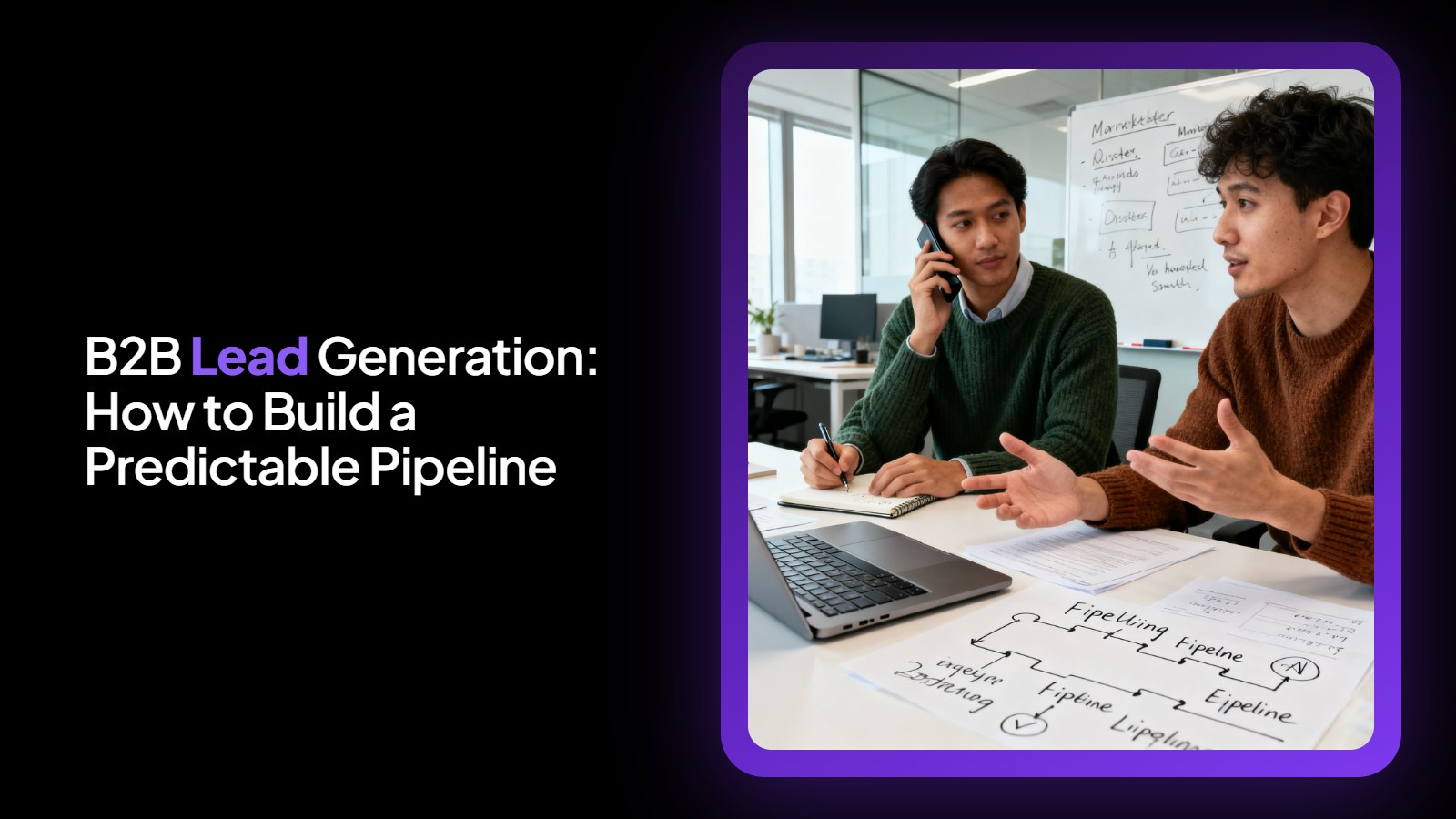
B2B Lead Generation: How to Build a Predictable Pipeline
Most B2B companies do not have a lead generation problem. They have a lead generation system problem. There is a difference between running a campaign that produces 50 leads one month and zero the next, and building infrastructure that generates qualified opportunities consistently regardless of whether anyone is actively running a campaign that week. The companies that scale predictably are the ones that have solved the system problem, not just the tactic problem. This guide breaks down what B2B lead generation actually requires in 2025 and how to build a pipeline that does not depend on constant heroic effort to keep running.
- Home
- Marketing & Advertising
- B2B Lead Generation: How to Build a Predictable Pipeline
- Posted on May 23, 2026
- By sariabdulsater
- In Marketing & Advertising
- Leave a comment
What B2B Lead Generation Actually Means
B2B lead generation is the process of attracting and converting businesses into prospects who have expressed interest in your product or service. Unlike B2C, where a customer can make a purchase decision in minutes, B2B buying cycles involve multiple stakeholders, longer evaluation periods, and higher average contract values. This means B2B lead generation is not just about volume. It is about generating the right leads from the right companies with the right level of intent, at a cost your business can sustain. A qualified B2B lead typically shares your target industry, company size, budget range, and has a problem your solution actually addresses. Generating high volumes of unqualified leads is one of the most common and costly mistakes in B2B marketing, producing work for sales teams without producing revenue.
The 4 Core Channels for B2B Lead Generation
No single channel dominates B2B lead generation for every business. The right mix depends on your deal size, sales cycle, target audience, and whether your buyers search for solutions online or wait to be found. That said, four channels consistently produce results across most B2B categories.
Paid social, specifically LinkedIn Ads and Meta Ads, allows for precise targeting by job title, company size, industry, and seniority. LinkedIn is the strongest channel for reaching senior decision-makers at specific company types. Meta Ads reach a broader audience at lower CPMs and work well for retargeting and top-of-funnel demand generation. SEO and content marketing build compounding organic demand over time, generating leads from buyers actively searching for solutions. This channel takes longer to produce results but delivers the lowest cost per lead at scale. Outbound prospecting combines cold email, cold calling, and LinkedIn outreach to reach ideal customers who have not yet entered your funnel. It is the fastest channel for new business generation when targeting is precise and messaging is strong. Referral and partnership programs generate introductions from existing clients, vendors, and complementary service providers. These leads convert at the highest rate because they arrive with built-in trust.
How to Build a B2B Lead Generation System
A lead generation system is not a single campaign. It is a set of connected components that work together to generate, qualify, and convert leads repeatedly. The first component is a well-defined Ideal Customer Profile that specifies the company characteristics, stakeholder roles, pain points, and buying triggers that make a prospect a genuine fit. Without ICP clarity, every other component underperforms because targeting is fuzzy. The second component is an offer and message match: what you are promising in exchange for a prospect’s attention and how that promise connects to their specific problem. Weak offers and generic messaging are the most common causes of poor lead quality. The third component is the channel infrastructure: ads accounts, content assets, outbound sequences, and partnership agreements that generate the flow of prospects. The fourth is conversion infrastructure: landing pages, lead forms, and booking calendars that capture interest and start the sales process. The fifth is a nurturing sequence that keeps prospects engaged from first contact through purchase decision, which in complex B2B sales can span weeks or months.
Measuring B2B Lead Generation: Metrics That Matter
Vanity metrics like impressions, clicks, and total leads generate noise rather than insight. The metrics that actually indicate whether your lead generation is working are cost per marketing-qualified lead (CPL), marketing-qualified lead to sales-qualified lead conversion rate, cost per acquisition (CPA), pipeline value generated per channel, and average sales cycle length. The goal is not to minimize CPL in isolation. A channel that delivers a higher CPL but also a higher lead quality score and shorter sales cycle may produce better ROI than a channel with lower CPL and poor lead quality. Building a reporting model that traces each channel’s leads through to closed revenue is the only way to make confident budget allocation decisions.
Common B2B Lead Generation Mistakes
The most damaging mistake is treating lead generation as a series of disconnected campaigns rather than a system that builds over time. Businesses start and stop channels before accumulating enough data to optimize, which means they never capture the compounding returns that come from sustained investment. Failing to define ICP before spending on ads or outbound is another critical error, producing high volume at low quality. Many B2B companies also underinvest in conversion infrastructure, running strong ad campaigns that drive traffic to generic homepages with no clear offer or call to action. Speed to lead matters enormously in B2B: research consistently shows that leads contacted within 5 minutes of submitting a form convert at significantly higher rates than leads contacted hours or days later. Slow follow-up is a silent conversion killer that no amount of better targeting can compensate for.
Frequently Asked Questions About B2B Lead Generation
Q: How long does it take to build a B2B lead generation system?
A: Building and stabilizing a multi-channel lead generation system typically takes 3 to 6 months. Paid advertising can generate first results within 2 to 4 weeks, though optimization to hit target CPL targets takes longer. Outbound sequences begin producing meetings within 30 to 60 days if targeting and messaging are dialed in. SEO-driven lead generation takes 6 to 12 months to show meaningful volume. The most common mistake is abandoning channels before they have had enough time and budget to optimize. Plan for a 90-day minimum commitment to any new channel before drawing conclusions.
Q: What is a good cost per lead for B2B?
A: CPL benchmarks vary significantly by industry, channel, and deal size. For high-value B2B services with $5,000 to $50,000 annual contract values, CPLs of $100 to $400 are common and justifiable. For enterprise deals with six-figure contract values, CPLs of $500 to $2,000 can still produce strong ROI. The number that matters is not the raw CPL but the cost per acquisition relative to customer lifetime value. A $500 CPL that converts to a $30,000 annual client is a far better investment than a $50 CPL that rarely converts to revenue.
Q: Should a B2B company focus on inbound or outbound lead generation?
A: Most successful B2B companies run both in parallel. Outbound gives you control over who you target and produces faster results but requires continuous investment. Inbound through SEO, content, and paid demand generation builds compounding returns over time and attracts buyers who are already researching solutions. The right balance depends on your sales cycle, deal size, and growth stage. Early-stage companies with limited budgets and specific target accounts often start with outbound for speed, then build inbound programs to scale sustainably over 12 to 24 months.
How YourGrowthPartner.io Approaches B2B Lead Generation
We design full-funnel lead generation systems for B2B and service businesses, combining paid media, SEO, and outbound infrastructure to build pipelines that run consistently. Every engagement starts with ICP clarity, offer validation, and the conversion infrastructure that turns traffic into pipeline. Learn more about our performance marketing services and demand generation programs, or explore our approach to B2B PPC for faster pipeline build.
Ready to build a B2B lead generation system that produces predictable pipeline? Book a free growth audit with YourGrowthPartner.io and we will identify the fastest path to qualified opportunities for your business.
 Sari SaterFounder, YourGrowthPartnerSari Sater is the founder of YourGrowthPartner, a B2B and ecommerce growth consultancy specialising in Meta Ads, lead generation systems, and revenue optimisation. She works with beauty, medspa, luxury, and B2B service businesses to build scalable acquisition systems that convert.Full profile →LinkedIn → FacebookTwitterLinkedIn
 Google Performance Max: How It Works and When to Use It
PreviousFractional CMO: What It Is, When to Hire One, and What to Expect
Next Sari SaterSari Sater is the founder of YourGrowthPartner, a B2B and ecommerce growth consultancy specializing in Meta Ads, lead generation systems, and revenue optimization. She works with beauty, medspa, luxury, events, and service businesses to build scalable growth engines that convert.
With a focus on paid social advertising, local SEO, and conversion rate optimization, Sari helps business owners move from unpredictable revenue to consistent, compounding growth. Her clients include medspa owners, ecommerce brands, construction companies, and service businesses across the U.S.
YourGrowthPartner combines data-driven strategy with hands-on execution, offering services in Meta Ads management, technical SEO, enterprise SEO, retargeting, display advertising, and growth consulting. Sari writes regularly on topics including local SEO, paid ads strategy, sales team building, and scaling B2B service businesses.
Recommended Posts
B2B Email Marketing Strategy: How to Drive Pipeline, Deliverability, and ROI
Customer Lifetime Value: How to Calculate, Benchmark, and Use CLV to Grow
B2B Content Marketing Strategy: How to Build a System That Generates Pipeline
Conversion Rate Optimization: The Complete Guide for B2B and Ecommerce
No comment yet, add your voice below!